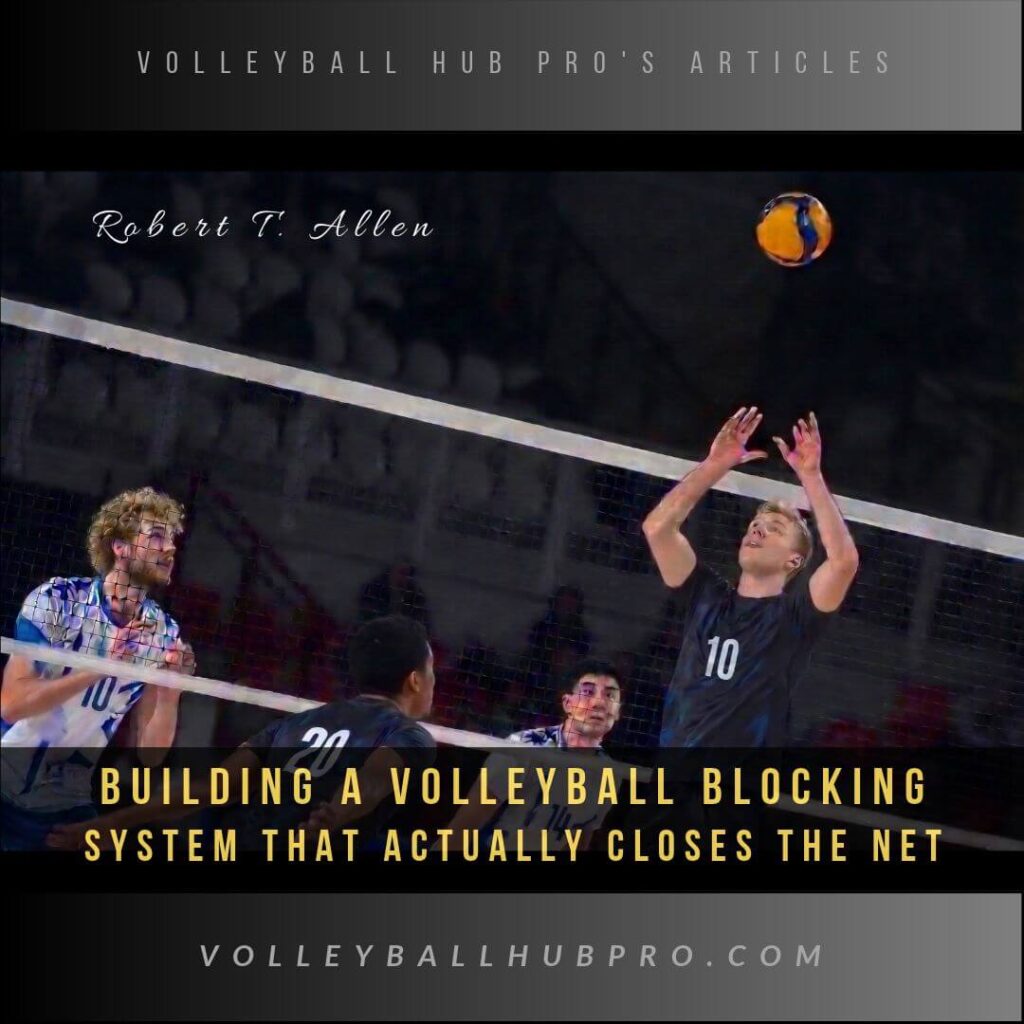
| Author | Robert T. Allen |
| Article Depth | Advanced / Technical Deep Dive |
| Required Knowledge | Intermediate–Advanced |
| Primary Audience | Intermediate and high-level volleyball coaches Performance analysts Technical staff |
Why Your Blocking System Fails Before the Ball Is Even Set
Walk into enough elite gyms across Europe and North America, and you will still hear coaches argue about blocking as if it were a theological choice between two rival faiths: read or commit. That binary is dead. Worse, clinging to it guarantees that your front row will bleed points against any setter who knows how to hold a middle attacker in the air. Empirical research, national federation curricula, and modern commercial coaching platforms have converged on a clear consensus: read blocking is the operational default across virtually every competitive tier, while commit blocking survives strictly as a selective matchup override rather than a base identity.
Yet the dogma persists, often fueled by bad film habits and locker-room folklore. Take the persistent myth that commit blocking dominates men’s volleyball because male attackers jump higher and hit faster. There is zero empirical support for that claim. In fact, notational match analysis by Afonso, Mesquita, and Palao on elite men’s volleyball demonstrated that anticipation, or commit, strategies failed to prove useful at the highest level, whereas non-anticipation read strategies correlated directly with higher block efficacies. When you watch a physical men’s match and see a middle blocker explode off the floor, you are usually watching dynamic swing-block footwork, not a blind pre-set commit. Confusing an athletic three-step swing mechanic with an anticipation system is one of the fastest ways to misdiagnose why a team actually closes the net.
The real coaching debate has moved well past the simple read-versus-commit argument. Today, high-level staffs wrestle with far sharper operational questions. When do you authorize a verbal, rally-by-rally “commit on call” override against a dominant middle without shattering your team’s visual discipline? Can a bunched starting alignment still close modern tempo-one pin sets, or does it leave your outside blockers arriving sideways? Should your read blockers press aggressively over the tape to hunt terminal stuff kills, or should they prioritize controlled touches that feed your transition offense? And how do you install a three-step swing progression without watching your team defense collapse for six weeks? Answer those questions poorly, and your system fails before the opposing setter ever touches the ball.
Every time a staff installs commit blocking as its primary defensive identity, it falls into a predictable geometric trap. Coaches love the visceral satisfaction of watching a middle blocker jump with the opponent’s quick hitter and bury a ball straight down at the ten-foot line. But what did that one highlight-reel stuff block cost you across the next five rotations? You can drill commit timing until your middles are blue in the face, yet if your defenders are not restructured behind them, you have not solved the offense. You have simply exported the crisis to the antennas.
Committing to the quick hitter operates on a brutal risk-transfer equation. By tying your middle blocker’s takeoff to the opponent’s middle attacker rather than the flight of the set, you guarantee that every set pushed to the outside or opposite faces a single, isolated blocker. That isolation immediately forces your back-row defenders to abandon their normal seams and shift wider and deeper to survive one-on-one attacks. Anyone who installs commit blocking without fundamentally re-engineering their back-row floor defense is just moving the problem backwards. And even worse is the coach who tolerates “half-committing,” where a middle takes a nervous hop or leans toward the quick hitter before trying to recover to the pin. That hesitation destroys both assignments: the blocker arrives too late to take away the middle’s angle and has zero momentum left to close the seam at the antenna. Even in high-level women’s volleyball, where the threat of the opponent middle significantly erodes your probability of forming a cohesive double or triple block, commit blocking is only empirically justified in a narrow, tactical window. Research by Afonso and Mesquita confirms that anticipation strategies reduce attack-point and positive-attack probabilities specifically when the opponent pulls a quick one-foot attack behind the setter, known as the slide. Outside of that specific weapon, or against a low-threat middle on a predictable pass, treating commit blocking as a base system merely hands the opposing setter open nets at the pins.
I have lost count of how many film sessions I have sat through where a staff celebrates three solo stuff blocks in a losing set while ignoring the twelve untouched swings that tore through their seam defense. If your blocking metrics start and end with box-score stuff totals, your front row is playing for the wrong scoreboard. A well-built block-defense system will never cover every possible attack angle on the court. Instead, it makes ruthless, deliberate choices about which attacks matter most and assigns both lines of defense, the net and the floor, compatible jobs. When a pin blocker understands their primary responsibility is to establish a clean outside edge, whether taking the line or funneling into the cross-court defender, the entire back row can read and react with conviction. In European read-blocking doctrine, the stated objective is not necessarily the terminal stuff point, but rather getting a controlled hand on the ball to simplify the transition counterattack. Whether your staff grades blocking on a zero-to-five control scale that rewards free-ball deflections or builds its identity around aggressive net penetration, the standard remains identical: cohesion beats heroism. Closing the net means synchronizing your blockers’ starting alignment, eye sequence, and lateral braking mechanics so that two pairs of hands arrive together, on balance, and in complete agreement with the defenders standing behind them.
Rules, Terminology, and Tactical Evolution
If you are still building your serving-team blocking fronts the way you did five years ago, you are leaving free geometry on the table. Under the 2025–2028 FIVB Official Volleyball Rules, Rule 7.4 fundamentally altered the pre-rally chessboard: at the moment of the service hit, the players of the serving team are completely free to occupy any position on their court, while the receiving team remains locked in rotational order until contact. Once the server strikes the ball, Rule 7.4.4 allows both sides to move freely. Think about what that removes from your front row’s workload. You no longer need to burn precious split-seconds after the serve watching your opposite and outside sprint across the court to switch, or having your middle fight through traffic to pinch into a bunched alignment. You can pre-align a bunched or matchup-specific blocking front before the server ever tosses the ball.
That structural freedom pairs with how the modern rulebook governs net contact itself. Under Rule 14, a block attempt without touching the ball is explicitly recognized, reaching beyond the net is legal provided you do not interfere prior to the opponent’s attack hit, and block touches still do not count against your three team hits. Simultaneously, updated provisions under Rules 9.1.2.3 and 23.3.2.3 allow play to continue through simultaneous opponent contacts above the net while adjudicating second hits crossing outside the antenna. Notice what is missing from the FIVB rulebook, though: the phrase “commit blocking” does not exist in the rules. The law governs space, timing, and interference; everything else is tactical architecture. And with Rule 7.4 removing rotational friction for the serving team, the burden of closing the net shifts squarely onto how fast your blockers read the pass and manage their feet.
While international rules opened up pre-serve spacing, U.S. collegiate volleyball simultaneously tightened the margin for error underneath the tape. Starting with the 2026 NCAA Women’s Volleyball season, a player’s foot completely crossing the center line is ruled an automatic fault, and more importantly, opposing coaches can burn a challenge review to contest whether a blocker’s foot crossed completely into their court. Do not underestimate how violently that rule changes the risk-reward math of aggressive net play. When a middle blocker commits tight to the net against a quick hitter, or when a pin blocker executes a high-velocity lateral swing block without arresting horizontal momentum, the landing is rarely vertical or symmetrical. Biomechanical force-plate studies on blocking landings show vertical ground reaction forces spiking up to six times bodyweight, accompanied by measurable unilateral foot-loading asymmetry during lateral moves. Even European federation technical manuals explicitly warn that run-and-jump lateral footwork increases invasion and net-penetration fault risk. Under the 2026 NCAA Women’s standard, an off-balance landing where a blocker’s lead foot slides two inches too far under the net is no longer a harmless scramble; it is a challengeable, point-losing fault. Cohesive blocking systems in NCAA women’s play now have to engineer braking mechanics not just to prevent drifting into a partner, but to keep both feet cleanly on their own side of the center line.
Before a coaching staff can adapt to those shifting margins, however, it has to stop using five different words for the same movement. Half the confusion in modern clinics comes from coaches mixing up starting alignment, footwork mechanics, and decision triggers as if they were interchangeable. In the North American AVCA framework, team blocking architecture is split into two base starting alignments, bunch and spread, and three system types: front, read, and commit. Yet walk into an Italian federation gym, and “front” disappears entirely as a system category, replaced by spatial and timing distinctions that are far more precise. Continental European coaching literature separates starting widths cleanly into wide starts (placing pins near the antennas for one-on-one coverage) and tight, bunched starts. From there, tactics divide cleanly by hand signal behind the back: an open-hand signal calls for read blocking, where the blocker delays takeoff until set direction is clear, whereas a closed-fist signal calls for the middle’s option or commit block, where the blocker anticipates by matching the quick attacker’s takeoff. Notice the trap waiting for anyone translating across borders. In Italian coaching terminology, an “option” block equates directly to a commit block, while scouting-based gambles are separated as intuition-based reads; in North American gyms, coaches frequently call a one-on-one matchup an “option,” conflate “guess” with commit, and use “swing blocking” as a system label when it is strictly an individual three-step footwork and arm-swing technique. Strip away the linguistic clutter, and every blocking system reduces to three independent variables: where your blockers start, how their feet and arms carry them to the ball, and what visual trigger launches them off the floor.
No static alignment built on those variables survives a full match against a competent setter, because offensive geometry keeps shifting between two incompatible threats. On one side, you have the relentless speed of tempo-one pin sets, which tempt coaches into spreading their outside blockers near the antennas so that every lateral move goes exclusively inward. On the other side, you have inside combination plays, active middles, and back-row pipe attacks that punish a spread front by leaving the middle blocker stranded in single coverage down the center of the court. Across decades of coaching debates, teams have oscillated cyclically between bunch and spread precisely because solving one threat exposes the other. Pass quality dictates which threat is actually live on any given rally. When serve receive breaks down and pushes the pass off the net, quick-attack frequency drops and offensive tempo slows, creating an environment where pure read blocking thrives and double-block closure rates climb. When the pass sits tight on the setter’s hands, however, middle-attacker availability immediately degrades your probability of forming a cohesive double or triple block. That tension is why modern high-level volleyball has abandoned rigid, one-speed blocking dogmas. You cannot play blind commit against a fast offense without wrecking your pin defense, and you cannot park in a passive spread alignment against a team running ruthless middle-and-pipe combinations. Modern net defense demands hybridization: a disciplined read-first base paired with dynamic starting widths and pre-planned, high-accountability tactical overrides.
Biomechanics and Execution
Every coach wants a blocker who jumps out of the gym and arrives over the net before the attacker swings. Unfortunately, human neuromuscular physiology refuses to give you both for free. In the canonical 3D stereophotogrammetry laboratory trials conducted by Lobietti, Fantozzi, and Merni, researchers isolated the exact kinematic trade-off separating the Read Block System from the Commit Block System. When a blocker commits, they execute an eccentric hip-extensor preload, a classic countermovement jump, which generates superior vertical elevation. When a blocker plays a true read system, they start close to the net with hands already up and knees bent, roughly around 120 degrees in traditional European read-blocking posture, and fire upward directly without a countermovement. Here is the paradox that catches coaches off guard: even though the read blocker’s peak vertical elevation is lower, direct arm extension gets their hands across the net in a significantly shorter time, while total upper-limb net penetration remains virtually identical across both systems. Think about what that means against a modern quick offense. Peak jump height three tenths of a second too late is useless; getting your hands into the attacker’s hitting window earlier beats jumping two inches higher after the ball has already cleared the tape. Of course, biomechanical trade-offs never vanish completely. Federation technical doctrine explicitly separates fast-movement posture (active legs with relatively low arms) from jumping posture (loaded legs with arms extended upward), noting that a read blocker can also manipulate timing to delay takeoff via a deliberate countermovement or arm drop when facing an off-speed or high set. Yet when speed at the net is the primary constraint, eliminating the countermovement preload wins the race to the ball.
What goes up at maximum effort has to come back down, and lateral blocking landings punish the lower extremities far more asymmetrically than most staffs realize. High-speed motion capture and force-plate kinetics from Lobietti and colleagues reveal that vertical ground reaction forces during spike and block landings spike as high as six times bodyweight for certain athletes. While spike landings generate significantly greater total impact than lateral blocks, blocking left and blocking right produce virtually identical jump heights and overall ground reaction forces, yet with a critical hidden catch. Lateral blocking induces measurable unilateral foot-loading asymmetry, overloading one limb depending on the direction of travel. Why should a tactical coach care about force-plate asymmetry? Because asymmetrical loading is the mechanical twin of horizontal drift. When a blocker sprints laterally to close a pin and fails to square their hips before takeoff, they land off-balance on one leg, carrying residual momentum straight toward, or underneath, the net. Under European coaching taxonomy, uncontrolled run-and-jump lateral mechanics are explicitly flagged for increasing net-penetration and invasion faults. And in NCAA Women’s Volleyball from 2026 onward, where a foot completely crossing the center line is an immediately challengeable fault, sloppy lateral landing mechanics no longer just wear down your middle blocker’s patellar tendons over a long conference season. They hand the opposing coach free points via video review.
Controlling that landing begins with refusing to apply one footwork pattern to every set distance. On short adjustments of one to two steps, a simple lateral shuffle keeps the hips square and the hands high. For medium-distance seams, a two-step crossover covers ground cleanly without sacrificing readiness. But when a middle blocker has to travel all the way to the antenna to close a fast pin set, only a three-step crossover (step, crossover, step) generates the horizontal velocity required to arrive on time. Regardless of the distance, the non-negotiable mechanical sequence remains the same: arrive, stop, jump, keeping the hands less than a ball-width apart so hitters cannot split the seam. At the highest speeds, elite programs pair that distance-matched travel with three-step swing blocking, codified in Gold Medal Squared’s Q3, x2, and x3 patterns. The first step is a small or negative lead step designed to open the hip toward the target pin. The second is an explosive crossover power step where the arms stay compact and low near the waist; you must kill any “swimming” motion with the elbows, which wastes time and pulls the shoulders out of alignment. The third step squares the blocker’s chest directly to the hitter rather than the sideline, launching one continuous press straight over the net with purposeful air drift only when closing a late seam. Drill this carelessly, and your blockers will fly past the ball; execute it with discipline, and they convert horizontal sprint speed into vertical wall presence.
How do you keep a 200-pound middle blocker moving at full sprint from crashing into your pin blocker or sliding under the tape? You teach them to block with their feet. As USA Volleyball’s national-team panel emphasizes, blockers must angle their feet sharply into the floor like a hockey stop on the final plant step, converting lateral momentum upward and slightly forward rather than letting it bleed sideways. If you watch film of a team that consistently gets tooled off the outside hand, look at their feet on takeoff: nine times out of ten, their toes are still pointing toward the sideline instead of angling back toward the court. Spacing off the net dictates whether that braking converts into real penetration. Standing too tight to the tape forces a blocker to reach straight up, creating a vertical ramp that smart hitters will bounce off all night. Standing slightly farther off the net, roughly a forearm’s length as modern European guides prescribe, allows the shoulders to press forward over the plane so you can get your hands as far across the net as possible and hold them there until gravity pulls you down. Even getting one hand across the plane beats reaching straight up with two. Yet there is one glaring tactical exception every pin blocker must memorize: when the set pushes the attacker outside the antenna, do not penetrate. Reaching over the net on a ball set outside the pin only hands the hitter a clean angle to tool your outside hand out of bounds; keep your hands vertical, protect the court, and force the attacker to hit around the tape.
Footwork without eye discipline, however, is just cardio at the net. Blockers who stare at the passer until the ball reaches the setter’s forehead are already beaten before they take their first step. Effective visual sequencing demands an early gaze transfer: track the serve or attack off the pass, read its trajectory immediately, and snap your eyes to the setter’s hand-contact window before the ball ever arrives. Hitters hit where the set takes them, which means the setter’s body, not the decoy middle screaming down the middle, holds the truth of the rally. Fix your gaze directly on the window where the setter’s hands will meet the ball, filtering out peripheral court noise, and read direction first, followed by set speed and location. Inside that contact window, national-team guidance highlights three reliable structural tells: the setter’s overall body orientation, shoulder angles, and spatial relationship to the ball, such as setters squaring toward left-back on back sets or leaning backward when forced to push a set under pressure. Experienced practitioners also track subtle wrist and hand positions on trained setters, noting that wrists tend to sit slightly more forward when pushing outside and more upright when releasing to the middle or opposite. Throughout that split-second read, your middle blocker must operate on a strict hierarchy of priority versus help. The opponent’s middle attacker is always the primary priority, while setter dumps and pin hitters are help assignments. Never let a middle blocker abandon their priority on a hunch; they hold their ground until their eyes confirm where the set is actually going, and only then do they explode to close the net.
Strategic and Tactical Architecture
Every great blocking system begins with an uncompromising default, because ambiguity at the net is an invitation for a good setter to dismantle your front row. Across national federation curricula, empirical match research, and modern commercial coaching platforms, read blocking stands as that baseline identity at nearly every competitive tier. Look at how Italian federation progressions structure athlete development from the ground up: after building general coordination between ages six and ten and basic technique from eleven to thirteen, their fourteen-to-seventeen game-system phase anchors the middle blocker squarely on read blocking, interpreting the set and sliding across the entire net to close zones two and four. Nowhere is blind commit blocking taught as a developmental foundation. That same logic holds as athletes move into club, high school, and lower adult competition, where read blocking consistently yields higher double-block closure rates. Quick-attack frequency is lower at those levels, and whenever serve receive pushes the opponent off the net, the offense slows down and funnels into predictable high sets. Even commercial platforms like Gold Medal Squared, which teach advanced Load, Dedicate, and commit tactics inside their upper-tier playbooks, insist that reading and reacting with clean mechanics and disciplined eyes outperforms elaborate tactical schemes for the vast majority of programs. Simplicity creates repeatability under scoreboard pressure. The moment you saddle a young or mid-level middle blocker with a labyrinth of pre-set guessing rules, you erode the very visual habits they need to survive in system.
Treating read blocking as your operational default does not mean sitting passively while an opponent’s middle attacker runs roughshod over your seam. It means elevating the commit block from a sloppy habit into a deliberate, pre-announced tactical override. The sharpest operational model for managing this hybrid reality is the “commit on call” protocol. Before the serve is tossed, your middle blocker evaluates the pass-and-setter matchup and calls out “commit” or “read” loudly enough for both pin blockers and the entire back row to hear. In continental European systems, that same pre-rally contract is communicated behind the back: an open-hand signal calls for a read block, while a closed-fist signal calls for an option-commit triggered by clear variables such as a front-row setter or pre-assigned defensive zones. That override must be explicit and vocal because your pin blockers and floor defenders cannot afford to guess whether they are getting middle help or whether they are stranded one-on-one. A middle blocker who silently decides to jump with the quick without alerting the outside blocker breaks trust across the entire defense. Even more toxic is the cardinal sin every serious staff must eradicate from day one: the “half-commit.” When a middle takes a nervous step or leans their shoulders toward the quick hitter before trying to recover to the pin, they lose both battles simultaneously, arriving too late to stuff the middle and completely stripped of the lateral momentum needed to close the antenna. While coaches still debate whether rally-by-rally verbal calls overload defensive cohesion, everyone agrees that half-committing is poison. If you authorize a scouting-based override, such as locking a middle onto zone four when film confirms the opponent’s middle, opposite, and setter attacks are low-threat or pairing pre-set line and diagonal rules with heavy setter tendencies, the call must be binary, loud, and executed with total conviction.
Knowing when to unleash a commit call matters far less than knowing when to lock it in the holster. Four specific matchup conditions strictly prohibit commit blocking, regardless of how badly a coach wants to manufacture pressure at the net. First, never commit against an offense featuring a heavy, reliable back-row attack, because jumping early with a front-row middle decoy leaves the pipe wide open down the center of the court, handing the opposing setter a free runway for their back-row attacker. Second, refuse to commit against ultra-fast hitting tempos where the setter’s release to the antennas leaves zero recovery margin; if your middle leaves the floor early against tempo-one pin sets, your outside blockers will face untouched swings all match. Third, do not call a commit when your pin blockers lack the physicality, footwork, or discipline to survive one-on-one at the antennas; calling a commit is an explicit vote of confidence in your pin defenders, and if they are getting beaten cleanly in single coverage, pulling their middle help away is tactical malpractice. And fourth, abandon commit calls late in tight sets when risk management outweighs forcing pressure, as well as on any out-of-system rally where an off-the-net pass already strips the opponent of their quick attack. When the pass forces the setter off the tape, offensive options collapse naturally; patience at the net turns those predictable high balls into effortless double-block points.
Even with your visual triggers dialed in, your front row still has to choose where to stand before the ball is passed. That alignment question, bunch versus spread, has fueled cyclical coaching debates for decades because each geometry solves one offensive problem by exposing another. In a bunched starting front, the pin blockers pinch inward toward the middle blocker, building a tight wall near the center of the court. Proponents of bunch-read systems argue that this narrow spacing creates proactive outward momentum angles, letting the block swarm middle attacks, inside combination plays, and back-row pipe threats before driving outward with three-step swing footwork. Spread advocates look at that same tight cluster and see an ambush waiting at the antennas. By parking pin blockers wide near the sidelines, their lateral travel becomes exclusively unidirectional, moving inward and maximizing their odds of arriving on time against blistering tempo-one outside sets. Yet that comfort at the pins carries a severe tax: it stretches the middle blocker’s sprint to the antennas to the breaking point and leaves your inside seams vulnerable to combination routes. How should a staff resolve that tension? Not by ideology, but by measuring the opponent’s setter-to-pin ball flight time against the frequency of their inside and pipe attacks. When an opponent lives on fast outside balls and rarely runs inside combos, spreading your pins protects your edges; when they weaponize the middle and the pipe, bunching your front restores your wall.
Once two pairs of hands arrive together at the point of attack, your system still has to define what success looks like at impact. On one side of the gym stand the roof-penetration advocates, championed in USA Volleyball and Gold Medal Squared doctrine, who demand that blockers press aggressively across the plane of the net to choke off sharp attack angles and terminate rallies outright with stuff kills, holding back penetration only on extreme sets outside the antenna. On the other side stand the control-block proponents, rooted in the European soft-touch counterattack tradition and zero-to-five block-grading scales, who argue that read blocking exists primarily to get a controlled touch on the ball, slow down the swing, and feed an easy transition opportunity. Whichever philosophy your staff prioritizes, your net front and your floor defense must operate as a single, indivisible unit. Pin blockers cannot improvise their hand angles from point to point; whether they are aligning directly on the attacker’s approach or sealing the line, their job is to establish a clean, predictable outside edge so the defenders behind them have compatible jobs. A pin blocker who turns their hands inward at the last instant to chase a personal stuff block steals the ball straight out of their defender’s seam. And the moment your middle calls a commit, your back-row defenders must immediately widen and deepen their base spots to absorb the inevitable one-on-one pin swings. Anyone who plays commit blocking without re-engineering their floor defense is not stopping the offense; they are merely moving the crisis backward.
One of the quickest ways to sabotage that system in practice is to misjudge when you install complex blocking mechanics. Teaching three-step swing blocking early in an athlete’s development, while motor patterns are adaptable and practice volume can be balanced cleanly against serve-receive priorities, builds an explosive long-term weapon. Try to cram a full swing-blocking overhaul into your roster mid-season, however, and your team defense will get noticeably worse before it gets better. Because changing footwork and arm carriage temporarily disrupts timing, spacing, and visual focus, staged coaching models insist on locking down eye discipline, lateral arrival, and landing stability before layering on full swing mechanics. When you do translate these tactical choices onto the practice court, your drill inventory has to punish guessing and reward full-court communication. Build visual patience first with Read-Then-Go, where a setter catches a tossed ball and sets zones four, three, or two while the middle blocker is forbidden from moving until release and must call the target aloud, drawing an immediate solo-block penalty on the next rep for leaving early. Pair that with Phase 1 Setter and Quick isolation reps where coaches intentionally delay sets to expose impatient middles, alongside Pass-to-Setter Gaze Transfer work that trains eyes to snap early onto the setter’s contact window. Next, bridge into live decision-making with a Commit-on-Call Scrimmage, forcing the middle to announce “commit” or “read” before every rally while banning half-commits outright. Sharpen judgment at contact through 5+5 Box Attack Recognition, requiring five aggressive stuff blocks and five soft control touches off an elevated coach while calling out every rebound direction and awarding bonus points for winning transition. Finally, stress-test reset speed and pin-defense coupling under six-on-six chaos using Activate-Terminate (forcing the first set to the middle before randomizing subsequent balls), the 3 Ball Game (entering the next ball only after every blocker completes a full block and ready reset), Line-or-Cross on Command, and classic coverage crucibles like Pin to Pin Pepper, the 3-Box Drill, and 5v5. That is how tactical doctrine survives fifth-set pressure.
Separating Verified Findings from Coaching Folklore
Spend ten minutes around enough gym rats, and someone will eventually tell you that men’s volleyball runs on commit blocking because the men jump too high and swing too fast for a blocker to read the set. That claim sounds logical until you actually open the peer-reviewed match literature. In their landmark notational analysis of elite men’s volleyball, Afonso, Mesquita, and Palao examined how commit blocking, the number of blockers closing the net, and overall block effectiveness interact under real match pressure. Their findings, later reported verbatim in Afonso and Mesquita’s 2011 work, cut straight through the folklore: anticipation strategies failed to prove useful in elite men’s volleyball, while non-anticipation read strategies demonstrated clear associations with higher block efficacies.
Why does guessing early fail so reliably against elite male setters? Because high-level men’s setters hold the ball long enough and disguise their release cleanly enough that any pre-set commitment by the middle blocker hands the offense an open highway to the antennas. When you sacrifice a double block at the pin to chase a phantom quick, you are trading a speculative gamble in zone three for an isolated one-on-one nightmare at zones two and four. Of course, an honest performance analyst has to put the 2005 study’s limitations on the table. The primary full-text sample sizes and tables from 2005 are unavailable in the retrieved open record, and that dataset predates modern men’s offensive tempos by two decades. Even so, no peer-reviewed match study has overturned its directional finding, and even modern grassroots practitioners who occasionally advocate a selective zone-four commit only do so when scouting exposes a glaring anomaly where the opponent’s middle, opposite, and setter pose minimal threat. As a rule, reading beats guessing when the ball moves fast.
If elite men’s data slams the door on commit blocking as a base system, high-level women’s match data reveals the exact tactical crack where selective anticipation earns its keep. In their 2011 notational study in the European Journal of Sport Science, Afonso and Mesquita analyzed elite women’s rally sequences, excluding setter dumps and setting errors, to isolate what drives block cohesiveness, defined as forming a unified double or triple block rather than a broken or single block, alongside opponent attack efficacy. Their numbers confirmed what every veteran coach feels in their gut: whenever the opponent’s middle attacker is available for a quick attack in front of or behind the setter, the probability of your front row forming a cohesive double or triple block drops significantly compared to when the middle is unavailable. Effective net defense in the women’s game is a three-way temporal regulation battle linking the middle attacker, the setter, and the ball.
Yet within that same dataset, Afonso and Mesquita identified one empirically justified exception for commit blocking. When a high-level women’s offense runs a quick one-foot attack behind the setter, known as the slide, anticipation strategies by the block measurably diminish the probability of an opponent attack point or positive attack. That is not coaching folklore; that is verified match evidence explaining why women’s staffs build “commit on call” overrides specifically for slide-heavy rotations. Because the one-foot slide requires a distinct lateral approach behind the setter, committing to it shuts down the attacker’s primary angle before she can unload. At the same time, you cannot lazily copy-paste that women’s exception into men’s volleyball, where one-foot slides behind the setter are uncommon, nor can you ignore that exact sample sizes and odds ratios were truncated in the retrieved archive. Respect the boundaries of the sample, and the tactical rule becomes crystal clear: read the setter by default, and reserve anticipation for the slide.
Match notation tells us what survives on the scoreboard; laboratory biomechanics explains why those outcomes happen inside three-tenths of a second. Across two canonical studies, Lobietti and colleagues placed both blocking strategies and lateral landings under 3D stereophotogrammetry and 500 Hz force plates.
| Empirical Study & Methodology | Variables & Systems Isolated | Core Verified Findings | Methodological Limits & Caveats |
| Afonso, Mesquita, & Palao (2005) Notational match analysis (via Afonso & Mesquita, 2011) | Commit vs. non-anticipation strategy, blocker count, block efficacy (elite men) | Commit strategies failed to prove useful; non-anticipation (read) strategies showed higher block efficacies. | Predates modern men’s tempos by ~20 years; primary 2005 tables and sample size unavailable in retrieved record. |
| Afonso & Mesquita (2011) Notational match analysis (elite women) | Block cohesiveness (double/triple vs. single/broken), attack efficacy, slide defense | Middle availability lowers cohesive block probability; committing against a one-foot slide behind the setter reduces attack-point and positive-attack probability. | High-level women’s sample only (not transferable to men’s play); exact sample sizes and odds ratios truncated. |
| Lobietti, Fantozzi, & Merni (2006 / 2009) 3D stereophotogrammetry lab trials | Vertical elevation, hand-arrival time, net penetration (CBS vs. RBS) | CBS achieved higher elevation via countermovement preload; RBS delivered hands over the net faster via direct squat-jump arm extension, with similar net penetration. | Lab simulation with coach miming setter (no live ball or attackers); Table 2 column headers/units omitted in retrieved excerpt. |
| Lobietti et al. (c. 2010) 500 Hz motion capture & force plates | Landing VGRF, jump height, bilateral foot loading (left vs. right blocks) | Landing VGRF reached up to 6 BW; spike landings exceeded block landings; left/right blocks matched in height and overall VGRF, but unilateral foot-loading asymmetry appeared. | Artificial wand-cue against suspended ball; internal text conflict between Discussion and Conclusion on which direction overloaded the right foot. |
Examining Lobietti’s 2006 and 2009 kinematic trials reveals the exact mechanical price tag of choosing commit over read. Across Table 2’s six summary columns, reported as means and standard deviations, the Commit Block System posted 0.38±0.14, 0.32±0.05, 0.60±0.01, 0.75±0.15, 442±29, and 135±7, while the Read Block System posted 0.18±0.20, 0.22±0.07, 0.56±0.02, 0.43±0.30, 364±34, and 141±21. Because the retrieved archive omitted the table’s explicit column headers and measurement units, any responsible analyst refuses to invent labels for individual columns. What the published Friedman statistical testing proves directly, however, is the biomechanical trade-off every coach must manage: the commit blocker’s eccentric hip-extensor preload generates greater vertical elevation, whereas the read blocker’s direct squat-jump arm extension gets the hands over the net in a shorter time while achieving comparable upper-limb penetration. Meanwhile, the 500 Hz force-plate kinetics against a suspended ball, set at 2.43 meters for men and 2.24 meters for women, confirm that lateral block landings generate up to six times bodyweight in vertical ground reaction force with measurable unilateral foot-loading asymmetry, even when jump height and total force appear identical between left and right moves.
Being data-driven means having the discipline to admit where the spreadsheet goes blank. First, we have to retire the unsubstantiated claim that commit blocking is more common in men’s volleyball than women’s. There is zero empirical evidence behind it. That misconception almost always stems from observers confusing explosive three-step swing-blocking footwork with pre-set commit systems, or importing fictional anime terminology into real-world gym analysis. Just as importantly, coaching staffs must strip out unverified second-hand aphorisms pinned on famous national-team coaches and anonymous forum claims tossing around arbitrary elite read-accuracy percentages without a single published dataset behind them. At the same time, we must face a glaring currency gap in our 2026 evidence base. The four canonical peer-reviewed studies anchoring this field date from 2005 to 2011. No 2023–2026 peer-reviewed match studies quantifying modern side-out efficiency, double-block closure rates, or error rates across read versus commit systems exist in the verified public corpus, nor do we have controlled empirical outcome datasets for youth or NCAA play. Commercial platforms like Gold Medal Squared, Koach Volleyball, and VolleyballXL provide coherent 2025–2026 tactical frameworks, yet their assertions about club double-block rates remain commercial doctrine rather than controlled empirical trials. And while 2025–2028 FIVB Rule 7.4 and the 2026 NCAA Women’s center-line fault rule are settled competition facts, their downstream effect on pin kill percentages and challenge error rates awaits post-season tracking. Until optical match tracking closes those gaps by measuring expected side-out efficiency on commit-on-call versus read rallies, double-block closure binned by ball flight time, and live-match 3D fingertip penetration, smart staffs must combine canonical lab and match evidence with ruthless, honest data collection inside their own gyms.
Auditing Your Own Net Defense Without Illusions
Walk into any coaching clinic hospitality suite after the evening sessions wrap up, and you will hear half a dozen second-hand aphorisms pinned on legendary national-team coaches, alongside confident declarations about professional read-accuracy percentages that nobody in the room can actually trace to a published dataset. Too much of our profession still runs on clinic folklore, commercial marketing slogans, and pop-culture caricatures of “guess blocking.” If you want a net defense that holds up in a fifth-set tiebreak against an elite setter, you have to strip that noise out of your staff room immediately. Commercial methodologies can hand you sharp progressions, and historical match studies can expose bad assumptions, yet neither one will close a seam for you next Friday night.
The real frontier of blocking analytics sits right inside your own video room. Instead of waiting for the next wave of published international studies to catch up to 2026 offensive tempos, build an internal audit around the exact variables that separate cohesive walls from broken ones. Track your opponent’s expected side-out efficiency on explicit “commit on call” rallies, including the kill percentage surrendered by your isolated one-on-one pin blockers, against your pure read rallies. Measure your double-block closure rates in bunched versus spread starting alignments, binned specifically by setter-to-pin ball flight time rather than vague eyeball impressions. Weigh your terminal stuff-block percentage and tool-error rate against your transition conversion rate off soft control touches. And if your program competes under 2025–2028 FIVB Rule 7.4’s pre-serve positioning freedom or 2026 NCAA Women’s challengeable center-line rules, log every pre-aligned front and every off-balance landing fault like your season depends on it. Because it does.
Do not wait until your next conference match or international tournament to discover whether your blocking system is an illusion. Walk into the gym tomorrow morning and put your front row through three ruthless audits during live six-on-six play. First, plant a camera behind your middle blocker’s shoulders during serve-receive and transition segments, and watch their head, not their hands. Are their eyes snapping off the pass straight into the setter’s hand-contact window before the ball ever arrives, or are they staring at the passer and panicking into half-commits? Every single time you catch a middle taking a nervous hop toward a decoy before bailing out to the pin, blow the whistle dead on the spot. Half-committing is a cancer; kill it before it spreads to the rest of your front row.
Second, stress-test the contract between your net and your floor defense. Before a single ball is served in your next scrimmage, force your pin blockers and back-row defenders to state their edge and seam responsibilities out loud, and demand a clear verbal “read” or “commit” call from your middle on every rally. Watch what happens to your perimeter defenders the instant a commit is called. If your outside defenders stay parked in their comfortable read spots instead of widening and deepening to protect the isolated pin blocker, your system is broken. You are just moving the crisis backward and praying the opposing outside hitter misses.
Finally, drop your camera angle down to the floor and film your blockers’ feet after full-speed three-step crossovers and tight middle jumps. Ignore the highlight-reel block touches for ten minutes and stare exclusively at the center line. Are your blockers driving their plant feet into a sharp hockey stop to convert horizontal speed upward without drifting into their partner, or are their ankles rolling and their lead feet sliding across the tape under six times bodyweight of unilateral force? Anyone can draw three neat arrows on a tactics board and call it a blocking system. The coaches who actually win at the net are the ones willing to film the chaos, throw out their favorite myths, and demand proof that two pairs of hands arrive together, on balance, and in total agreement with the court behind them.
Scientific Bibliography
Afonso, J., & Mesquita, I. (2011). Determinants of block cohesiveness and attack efficacy in high-level women’s volleyball. European Journal of Sport Science, 11(1), 69–75.
Afonso, J., Mesquita, I., & Palao, J. M. (2005). Relationship between the use of commit-block and the numbers of blockers and block effectiveness. International Journal of Performance Analysis in Sport, 5(2), 36–45.
Araújo, R. M., Castro, J., Marcelino, R., & Mesquita, I. R. (2010). Relationship between the opponent block and the hitter in elite male volleyball. Journal of Quantitative Analysis in Sports, 6(4), 1–12.
Gogoi, D., & Pant, G. (2017). A comparative study on eye-hand co-ordination ability between attackers and blockers in volleyball. International Journal of Research and Analytical Reviews, 4(2), 52–55.
Legg, L., Peel, S., Donahue, P., Piland, S., & Thorsen, T. (2025). Lead limb landing mechanics between volleyball tasks and shoe collar heights. Cultura, Ciencia y Deporte, 20(63), 2082.
Lobietti, R. (2009). A review of blocking in volleyball: from the notational analysis to biomechanics. Journal of Human Sport and Exercise, 2, 93–99.
Lobietti, R., Fantozzi, S., & Merni, F. (2006). Blocking the quick attack in volleyball: a 3D kinematic analysis. Proceedings of the XXIV International Symposium on Biomechanics in Sports (ISBS).
Lobietti, R., Fantozzi, S., Stagni, R., & Coleman, S. (2009). Landing forces in volleyball spiking and blocking. Proceedings of the XXVII International Symposium on Biomechanics in Sports (ISBS).
Loureiro, M., Hurst, M., Valongo, B., Nikolaidis, P., Laporta, L., & Afonso, J. (2017). A comprehensive mapping of high-level men’s volleyball gameplay through social network analysis: analysing serve, side-out, side-out transition and transition. Montenegrin Journal of Sports Science and Medicine, 6(2), 35–41.
The Guides of Volleyball Hub Pro
If you’re looking to delve deeper into this topic, I highly recommend reading the following books authored by our team: